
Welcome to Chez Alpha Books - Dakar, Senegal
Chez Alpha Books and English Language Services
  • HOME
    • About Chez Alpha Books
    • About the Founder- Artist Angela Franklin
  • BOOKS
    • New Books Available
    • Book News
  • EDUCATION
    • English Classes
  • COMMUNITY
    • 4Ever Reader Book Club
    • Community Activities
    • We Read Program
    • Library
    • Blog
  • STORE
  • New Page

Quand un étudiant doit mettre ses intérêts en avant

10/25/2013

0 Comments

 
Picture
Arriver quelques semaines en retard à l’université peut
ressembler à un grand effort de dernière minute consentit par l’étudiant pour réussir ; néanmoins dans le souci de faire le choix qui répond le mieux à ses intérêts ; l’étudiant doit y réfléchir consciencieusement.  C’est un moment très critique pour l’étudiant qui est à la quête de l’université qui lui conviendra le mieux.  Du fait qu’ils sont confrontés à des questions diverses liées à l’université à laquelle ils devraient s’inscrire, le programme qu’ils devraient suivre, où est ce qu’ils devraient étudier et beaucoup d’autres questions, les étudiants devraient opérer des choix judicieux basés sur ce qui répond le plus à leurs besoins en termes de culture, vie sociale et sur le volet académique.

Il y a quelques semaines de cela, nous avions travaillé avec plusieurs
étudiants qui ont reçu tardivement des lettres d’admission. Malgré le retard accusé, ces étudiants étaient toujours prêts à partir sachant que les cours avaient déjà débuté.  Ces mêmes
étudiants rétorquent systématiquement à qui soulève le problème du retard, que
leurs universités leur ont assuré qu’ils pouvaient toujours venir même s’ils
risquent fort probablement de commencer légèrement en retard! Nous avons beau
être conscients du fait que ces étudiants sont très emballés à l’idée de se
lancer dans cette nouvelle aventure, mais nous pensons également que nous
devons, du mieux que nous pouvons, les convaincre d’attendre le prochain
semestre ou la prochaine année, le but étant de commencer à temps, en même temps
que leurs autres camarades. Nous comprenons qu’ils peuvent avoir une lettre
d’admission ou un visa d’étudiant qui peut leur permettre de rejoindre leur
destination dans les 3-4 jours ; néanmoins, nous voyons plus loin que cela
lorsque nous insistons sur les étudiants pour qu’ils patientent


Nous basons notre insistance à ce qu’ils patientent et qu’ils arrivent
à temps pour les cours sur notre expérience dans le domaine.  Nous
savons que très souvent, les étudiants internationaux font face à d’énormes
difficultés.  Etant éloignés des leurs, ils sont placés dans un
nouvel environnement, de nouvelles cultures, de nouveaux amis, et peut être
même de nouvelles langues. Les universités organisent des sessions
d’orientation afin d’aider les étudiants à s’intégrer dans leur nouvel
environnement.  Cette orientation peut s’étaler sur une journée ou sur
une semaine entière d’activités organisées dans le but de familiariser les
étudiants aussi bien à la vie au niveau du campus qu’à leur nouvelle ville.
Durant cette période, les étudiants apprennent à se déplacer au sein du campus,
à acheter leurs livres scolaires, et à se familiariser avec les responsables de
la faculté et ainsi s’intégrer dans la grande communauté
estudiantine.


Les étudiants qui arrivent tardivement perçoivent cela comme
s’ils sautaient automatiquement dans leur quotidien scolaire sans
transition et donc rien de très grave. Par contre, nous pensons, compte tenu de
notre expérience, que le fait d’arriver en retard peut avoir un effet
négatif  à long terme sur l’étudiant.  Les étudiants en
retard auront perdu 2-3 semaines de cours en plus de la période cruciale
d’introduction pour chaque cours.  Ils sont également susceptibles de
trouver les membres de la faculté avec une charge colossale de cours à enseigner
et cela les rendra peu disponibles pour les aider à prendre le train
en marche.  Les sentiments initiaux de désarroi et de confusion dont
les autres étudiants ont déjà fait l’expérience durant leur première semaine peu
rester chez les retardataires beaucoup plus longtemps en même temps qu’ils
essayent de se rattraper. Les universités fonctionnent comme les entreprises;
elles ont des objectifs à atteindre en termes de nombre d’étudiants inscrits par
an et en termes de revenus annuels, et c’est la raison pour laquelle un étudiant
qui arrive en retard profite plus à l’université qu’il ne se profite à
lui-même. Le plus important c’est que beaucoup d’étudiant arrivent en
retard et se donnent corps et âme pour rattraper les cours manqués mais se
retrouvent avec des notes en dessous de la moyenne.  Ils doivent se
rappeler que lorsque les professeurs donnent les notes, ils peuvent ne pas tenir
en compte le fait qu’ils sont venus légèrement en retard et qu’ils ont raté
certains cours.  A ce moment là, il est fort possible que l’étudiant
soit noté sur la base de ses performances: s’il a bien travaillé ou
non.  C’est pour cela que nous demandons à chaque fois aux étudiants
de mettre leurs intérêts en avant parce que s’ils ne le font pas qui le fera à
leur place?


0 Comments

October 25th, 2013

10/25/2013

1 Comment

 
Picture


1 Comment

When a Student Must Look Out For Their Own Best Interest

10/20/2013

0 Comments

 
Picture
 Arriving to the university a few weeks late may seem like a great
last minute effort to make it there but a student should really think about if
this is in their best interest. The university search is a crucial time when a student must think about what is bestfor him or her.  Confronted with various choices regarding what university to attend, what to study, where to study and more students should reach their final decisions based on what is in their best interest academically, socially and culturally.   

 In  recent weeks, we have worked with several students who received a late university admission.  Despite being late, these students are ready to go although classes have already started.  These same students are quick to say that the university has told them they can still come although they may be starting a bit late!

Recognizing how excited students are about this new experience, we still feel it necessary to encourage them to wait for the next semester or year in order to begin on time with their classmates.  We understand that they may have an
admission letter and student visa that may allow them to slide in the country within 3-4 days, however our insistence on students waiting goes beyond this. 

Our reason for asking them to wait and arrive on time for classes is based on experience.  We know that often international students face many challenges that can be overwhelming.  Away from home they are confronted with a new location, new cultures, new friends and maybe new languages.  Universities organize their orientation programs to help students transition into their new surroundings.  This orientation program can consist of one day or one week of activities designed to introduce students to both campus life and their new city. During this period students
learn to navigate around campus, purchase books, become familiar with their faculty and become integrated into the wider campus community.

Students ready to arrive late see it as just jumping into their classes. However based on our experiences, we believe that arriving late can have a long term negative impact.  Late students will have missed 2-3 weeks of class along with the crucial introductory period into each course.  They may find that faculty with heavy teaching loads are not easily
available to sit down and help them catch up.  The initial feeling of being overwhelmed that other students confronted during their first week may stay with late students for a longer period of time as they try to catch-up. 
 
Universities like business have target numbers and projected revenues therefore a student arriving late may be of more benefit to the institution than to them.  Most important, I have seen students arrive late and struggle to catch up with the work missed and ultimately earn below average results.  Students must remember when the grades are given out professors may not take into account that you came late.  At that moment you may find yourself graded on whether you did or did not succeed.  This is why we tell students to think about what is in their best interest because if they don’t do this then who will?


0 Comments

When “Passable” May not be Enough!

9/24/2013

1 Comment

 
Picture
After Bac results are released, Chez Alpha Books is often besieged by students who are desperately seeking to begin their studies at a university abroad in September.  With less than two months before the admission deadline, it is often a mission impossible when these students have not thought about their university admissions process before receiving their results.

Year after year, we encourage students who plan to study abroad to begin the application process early.  When we say early, we mean in “seconde” or “première”. Students dreaming of studying in an English-speaking institution that requires the SAT/ACT or TOEFL must understand that the earlier they began to prepare for these exams the better.  By starting early students also have time to re-take the exam if they do not meet their desired results. In reality, “terminale” is much too challenging a year for a student to also have time to focus on these tests.

In the French higher education system, most universities will accept a student when they have successfully completed the Bac even with a “passable” result.  North American universities or colleges in addition to the Bac will probably ask for 2-3 years of “ relevè de notes”.  For this reason, we urge students to understand that merely completing the Bac with a “passable” is not enough to be admitted to their first choice university. Students should focus on earning good results throughout secondary school.

Starting early may not guarantee 100% success however it can provide students with the time needed to work efficiently towards the desired results.


1 Comment

First Steps and a Great Education Plan

8/23/2013

1 Comment

 
Picture
There is a Chinese proverb that says: “Every great journey begins with a single step.”  When it comes to students embarking on an educational journey, I also believe that this single step should be accompanied by a great plan. 

If plans are a method to achieve an end, then each plan needs to be developed, reviewed, edited and re-defined when necessary.  As parents and educational leaders we need to begin helping students implement their plan sooner than later because students do not just arrive at the university.  In reality, the journey begins early when students are young and we as family, friends and mentors take their hand and empower them to see that higher education can be an attainable dream.  

The plan is put in place as they enter primary school or even before when we begin to emphasize learning as a joyful process. It continues when we celebrate their achievements and collectively determine goals and objectives for the next year.  This plan becomes a reality as the years go by and we help our children understand that learning is not just for a moment, but for life. The education plan starts to appear obtainable when we encourage students to explore an array of career opportunities that are interrelated to both their skills and interests.  

Via day to day experiences, television or from the pages of history we introduce children to people who are just like them and also went on to obtain an education. We lead students to a greater understanding of what options are available based on their financial resources, academic merit and geographical location. I say this as I am certain there is an education option for everyone yet recognize that without significant financial resources the journey can be long and hard.  But if the educational plan is interlaced with a strong sense of reality, adaptability and support it may be achieved.

As the journey begins to wind down and our children arrive at the university application process, we should do our best to support their decision and when necessary connect them to a teacher, counselor or mentor who may provide answers for crucial questions if we are unable to help them.  Completing the application, creating the personal statement, respecting admission requirements and application deadlines are all part of the educational plan. We can best help students in this aspect of the journey if we enable them to understand that while admission requirements, policies and deadlines are often not negotiable they can demonstrate their adaptability and select another university that is a better fit for their educational plan.

With a plan in hand, we soon find that this journey that appeared difficult to navigate may also be enjoyable.  For families and students who have already embarked on this educational journey, it’s also important to recognize the time and place to support another student starting with their first step!


1 Comment

Engaging Young Readers in Dakar, Senegal - One Book at a Time!

6/7/2013

1 Comment

 
Picture
A recent New York Times article titled, “In Raising Scores, 1 2 3 Is Easier Than A B C” focused on the challenges that many schools are confronting in the U.S. with helping disadvantaged children develop strong reading skills in comparison to consistent gains seen in math skills.  Teachers and administrators when confronted with this reading challenge were left to ask, “Is it a vocabulary issue?  A background knowledge issue?  A sentence length issue? How dense is the text?”  What is the reason these students struggle to learn to read while at the same time being able to grasp math concepts?

 The article continues to say that, “Teachers and administrators who work with children from low-income families say one reason teachers struggle to help these students improve reading comprehension is that deficits start at such a young age: in the 1980s, the psychologists Betty Hart and Todd R. Risley found that by the time they are 4 years old, children from poor families have heard 32 million fewer words than children with professional parents. By contrast, children learn math predominantly in school”. 

Knowing that the acquisition of good reading skills begins at an early age the challenge is for parents to introduce their children to a world of books and literacy support in the home to support the reading program delivered in school.  While this is easier said than done, for students learning English as a Second Language of whatever income the challenges can be even greater particularly if the parent does not have the reading level to support the child’s development. 

When the Library Loan program was opened at Chez Alpha Books, it was based on the belief that somehow a mixed blend of selling new books while offering books for loan could be viable within the community and serve a variety of audiences. For many students and families the library loan program has become a lifeline that connects them to further develop or maintain a passion for books. To our delight, Senegal represents a reading audience still embracing the traditional book format and not yet so carried away by Kindle and Nook that the traditional book format is no longer interesting.   Day by day we continue to share with library loan members the importance and the magic of developing strong reading skills.

Research has clearly shown that the more children read, the better they become at reading.  It is true that practice makes perfect!  If they like what they are reading they will read more often and really commit to finishing each book. As they become older they will be able to take this love of reading and transfer it into their ability to do research and access information. Children who read often develop a bigger and more diverse vocabulary. This growing vocabulary will also be useful to develop their writing skills and oral speaking abilities. Most important, parents should emphasize that reading is not just to complete homework. It is both an academic and recreational activity. Reading should be viewed as a pleasurable activity - as a source of entertaining tales and useful and interesting factual information.

While educators often focus on the importance of the parent reading to their child, my life is living proof that the constant presence of books and a day to day encouragement to read can introduce a young learner to the passion of reading for life.  Growing up books were everywhere in my home. They were not always new, shiny books. Some were new and others found at thrift shops or yard sales.  In my family, learning to sign your name was the key to become a certified library card holder.  Weekly we walked to the library and through the hottest days of summer and the snowy days of winter we read and re-read book after book. We read by flashlight when we were told to turn of the light and go to bed and propped books up on the breakfast table to multi-task by reading and eating before we knew about multiple skills.  We read for pleasure and sometimes through pain as we struggled to build a larger vocabulary, decode words, and overcome the complexities of reading.

Then one day I went off to college with a box of books in hand and the knowledge that I would soon be surrounded by many more.  On the first weekend that I was able to return home, I stopped in the campus bookstore and bought I KNOW WHY THE CAGED BIRD SINGS by Maya Angelou. I entered my home with so much excitement and told my mother that I had a book that she was sure to love.  She looked at me and calmly said, “I hate reading and always have!”  I reminded her that we had read our entire life and that she had encouraged and almost forced us into reading sometimes.  I asked her to remember the many days we had sat on the front porch with a book in hand and we were encouraged to read.  Her final response was, “Yes, I sat with you all of the time and yes I always had a book on my lap but you didn’t notice that I never turned a page because I hate reading.  But I wanted all of you to love reading!”  And there it is.  This method of encouraging a child to read did not require a professional degree or a large amount of money.  As one comment related to the article “In Raising Scores…” said, “Nothing can replace the experience of sustained and engaged reading throughout childhood.”  My mother knew this and she was not the working professional but there must be other mothers like her who will take advantage of any and all resources available and we hope that the Chez Alpha Library Loan program is their first stop!

                                                  http://www.chezalphabks.com/library.html  

               http://www.nytimes.com/2013/05/30/education/reading-gains-lag-improvements-in-math.html


1 Comment

The Intellectual and 21st Century Skills for Life and Work

5/3/2013

0 Comments

 
Picture
“I am an intellectual” is how a student recently described himself to me.  This explanation was in response to my push for an increased use of e-technology for a specific educational project. With these words, the student attempted to both distance and absolve himself of any necessary relevant connection to innovation and technology. If this was the first time this had been said to me, I could have walked away yet within the last year I have had both student interns and job applicants applying to teach English describe themselves in this way.

 For each self-defined intellectual, I wanted to encourage them to understand that while the fact that they have 5 or 6 degrees is to be admired it would also be to their benefit to make sure they are gaining the necessary 21st century skills for life and the workplace.

In an article titled, “Create, Collaborate, Communicate: Empowering Students with 21st Century Skills”, it
says, the top three things employers are looking for in new recruits are:
     - Creative problem solving
     - Critical and analytical thinking skills 
     - Information gathering and evaluation
At the same time valuable 21st century competencies that schools are now encouraged to teach include the"Four ‘C' Skills:" critical thinking and problem solving, communication, collaboration, and creativity and innovation.

Self-defined intellectuals may need to ask themselves, if necessary, do I have these skills and competencies that can
enable me to thrive and survive in the 21st century. If the answer is no and these skills are desired for personal or professional reasons then it may be the time to develop a plan as to how to acquire them. 
 
Students preparing to enter the university need to make sure their initial educational experience encourages and supports their embracing the four C skills while the self-described intellectual should seek internship and career opportunities that encourage greater development of skills in these areas.

Bringing these skills to a professional work experience along with educational degrees may be a clear plan of success!. 


0 Comments

The Scholarship that Might Get Away!

4/23/2013

2 Comments

 
Picture
“Aidez Moi” “Help Me” is what I have read numerous times during
my many years of working in the area of student recruitment and
admissions.

 For many students from developing countries, I
have found this is often a common manner of beginning their scholarship
application in order to emphasize their impoverished lifestyle. 
I have read applications where students continue on to detail the daily
challenges they confront saying,

“My country is recovering from a civil war and I have no funds to pay….”
“My father is ill and my mother is unable to work…”
“I suffered a serious financial setback and have been unable to pay my fees to complete the university here and therefore I am asking you for a scholarship.”

These testimonials continue with students not realizing that these comments designed to encourage an outpouring of financial support can also have an adverse impact. How?  A scholarship committee can easily perceive these pleas in a different manner.  For example, the student unable to pay his tuition fees in his  homeland which are probably significantly cheaper may face a much greater financial challenge if the scholarship only pays 60% leaving the student responsible for the remaining 40%.

The student who shares the fact that their father is sick and cannot work along with a mother who is unemployed may easily create an image for the scholarship committee of someone with little or no financial
support.  At the same time, admitting to be from a war torn area with no money may also indicate to the
committee that as an applicant this student will join the group of numerous other students from other war torn regions of the world already on campus.

Today’s challenging economic times have made the quest for international scholarships very competitive. As the economy has stalled for many countries funding for universities has decreased and scholarships for international students have in many cases suffered more cuts.

It is important for students to understand that even a full scholarship still requires a certain level of financial responsibility for the student and parents. If tuition is covered you will still be left with the cost of an airline ticket, visa, housing, books, monthly expenses, etc.

When a scholarship or financial aid office sits down to review scholarship applications the same plea of “Aidez moi” that can cause one institution to fund you can also cause another institution to bypass your application.

Why?  Well they may view you as in need of more support than they can provide.  Also universities are looking not just to support a financially needed individual but someone with excellent academic results. Most important, do not
be surprised, if the university has the attitude of “Aidez nous-Help us” as many universities are seeking to support students that will bring a level of energy, engagement and community awareness to their campus!


2 Comments

Cost of Higher Education

3/31/2013

0 Comments

 
Picture
For many students and parents, higher education is something they
always dreamed of. I often speak with students who tell me that for years their parents have been emphasizing that they want them to study abroad. Key destinations are often the UK, US or Canada.

What many parents and students may not realize is just as the price of food, gas, clothes and cars has rapidly increased, so has education. In fact, higher education may now reflect the largest increase!

In a 2012 Huff Post article on higher education costs it stated, "The cost of a college degree in the United States has
increased "12 fold" over the past 30 years, far outpacing the price inflation of consumer goods,
  medical expenses and food.  According to Bloomberg, college tuition and fees have increased 1,120 percent since records began in 1978."

The attached podcast is an introductory guide to what students and parents should think about when they are planning to study abroad. We hope it provides a realistic introduction to the budget you will need to think
about.
http://www.huffingtonpost.com/2012/08/15/cost-of-college-degree-increase-12-fold-1120-percent-bloomberg_n_1783700.html


Before You Go: Creating a Budget to Study Abroad:podcast

0 Comments

A Big Name School

3/22/2013

1 Comment

 
Picture
 

I often hear international students tell me that they are looking for a "big name school". Everyone is looking for a "big name school" while in reality this does not mean they have big name school money or that the "big name school" is the best study option.  What is most important for students to know when they begin their university search is that a true education is really more than just a name!

Key Factors
Often international students do not realize other key factors that should be taken into consideration as they search for a university program.  Caliber of faculty, career placement and professional development, international student support services, accreditation and ranking are factors that many students fail to think  about as they begin searching for a university.

Faculty
The faculty we study from including their expertise, professional reputation, research credits and professional connections should be a a focus point specifically for students searching for graduate programs.  At the graduate level, you will be enrolled in a focused program and develop strong ties with your faculty.  Their recommendations and connections can be a major asset to help you transition into the professional arena. Learning from and working with faculty who are well recognized and respected in their field is also important. In addition, it is important to know about both their professional experience and educational credentials.  If you arrive at a big name school and then learn from faculty who have not published in twenty years, do not present at conferences, have no connections to share with you, etc. it may not be the prestigious experience you expected.

Accreditation
Accreditation is important and students can easily find on the university website the names of various bodies that accredit the institution.  In some countries, international students who study at universities abroad that are not accredited may have problems when they return home should they attempt to continue their studies or seek positions with certain organizations. 

Career Placement and Professional Development
Career placement and professional development support services are also key areas.  Students who still believe that merely having a degree from a "big name" school will be their passport to professional success are badly mistaken.  In today's competitive employment market having both hands on practical experience is a necessary alignment with your degree.

International Student Support Services
Most important, when international students have traveled far from home it is important to have needed support specifically in the initial transition period. Students would be wise to look closely at the programs and support offered to international students.  Check out if there is an office specifically dedicated to helping international students with the basic issue like airport pick up and opening a bank account to more complex issues of finding off-campus housing or organizing monthly activities to bring students together to form a community.

Big name schools can be wonderful as long as all of the benefits both in and out of the classroom are in place waiting for students when they arrive.

Read this: 

http://www.presspublications.com/education/5332-look-beyond-the-brand-name-when-choosing-a-college

Visit: http://chezalpha.blogspot.com


1 Comment
<<Previous
Forward>>

    Author

    Angela Franklin - Educator, Visual Artists, and Founder/Director of Chez Alpha Books:
    [email protected]

    Archives

    March 2018
    September 2017
    April 2017
    October 2016
    September 2016
    August 2016
    March 2016
    December 2015
    September 2015
    March 2015
    February 2015
    December 2014
    October 2014
    September 2014
    May 2014
    April 2014
    March 2014
    January 2014
    December 2013
    November 2013
    October 2013
    September 2013
    August 2013
    June 2013
    May 2013
    April 2013
    March 2013
    November 2011

    Categories

    All
    African Students
    Conversation Group
    Dakar
    Els Language Center
    English Language Center
    English Language Programs
    International Education
    Key Factors In University Search
    Learn English
    Library In Africa
    Selecting A University
    Senegal
    Student Recruitment And Admissions
    Study Abroad
    University Search

    RSS Feed

Picture

Chez Alpha Books
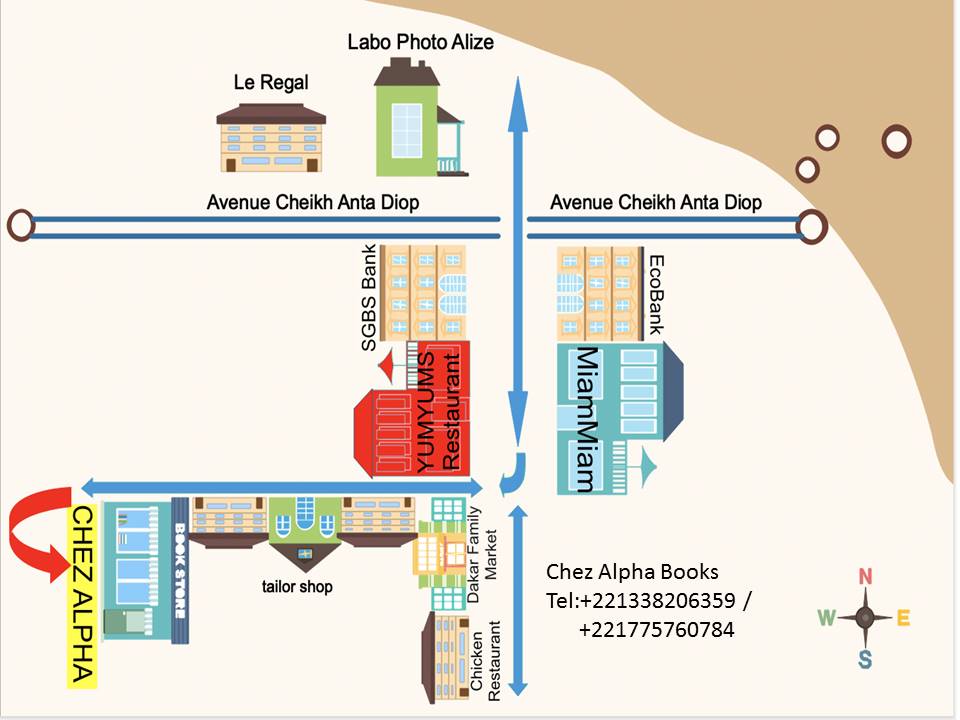
Location:  Behind YumYums
                    Ouakam-Cite Africa
​                    Dakar, Senegal


​Hours:       Tuesday-Saturday 10h-18h
Tel:            +1 221 77 576 07 84 (WhatsApp)
                   +1 221 33 820 6359 (Bookstore)
Email:       [email protected] and                                   [email protected]

Privacy Policy:  Contact information shared with Chez Alpha Books will not be shared with other organizations.
In addition, clients who no longer wish to be contacted can indicate this via email and their choice will be fully respected. ​